Wednesday, August 27, 2008

Aim vs. tactics

The skill-level of the higher echelon of a given game player base increases as one or more of the following occurs:

1. The quantity of the player base increases.
2. The maturity in terms of number of played man-hours increases per player.

In regards to 1v1 gameplay, aim and tactics are always important, but which is more important? Let's define the terms first, using my favorite FPS series Quake as the benchmark. The same definitions can be shifted slightly to apply to other popular FPS benchmarks like Counterstrike.

Aim - To direct a weapon towards an intended target.

I, as a player, have to manage my hand-eye coordination in order to move my mouse precisely to the proper pixel space on the screen, taking additional care based on whether I am using a projectile weapon (plasma gun, rocket launcher, grenade launcher) or a hitscan weapon (machinegun, shotgun, lightning gun, railgun). For projectile weapons, there are additional variables on how to manage hand-eye coordination based on the speed or trajectory of the projectile.

Plasma fire spam is extremely quick and straight. Rockets are moderately fast and straight, but also do splash damage so the best risk-to-reward is to hit a player directly on their feet. Hitting a player directly on their feet will often be rewarded with a direct hit and, therefore, maximize the amount of damage inflicted. If the shot is slightly off, the rocket still hits on the ground near the target's feet to inflict splash damage - the closer the shot to the target, the higher the amount of splash damage done. Grenades have an arcing trajectory and are best, like any other weapon, when the shot directly hits the target. Due to the arcing trajectory, they are slightly more awkward to aim and, as a result, are often spammed (shot in great quantity) in order to create higher quantity of risk for the opponent.

Players can respond to projectile weapons by dodging the fire. Different dodging patterns work better on certain player styles over others, but there are generic dodging patterns that tend to work advantageously overall.

For hitscan weapons, the only limitation to hitting your opponent is the requirement to be in line of sight of the opponent. If you can see your opponent, you can hit them.

Conversely, dodging hitscan weapon, on a technical level, is not possible. However, certain dodging patterns play on standard human hand-eye reaction models to trick a player into aiming improperly and missing their shot. Players who have control over their mental game and are never tricked will never miss because of opponent dodging techniques. There's no current player like this though (although some players impressively come close sometimes).

Tactics - A procedure or set of maneuvers engaged in to achieve an end, an aim, or a goal.

In our benchmark case, the goal is to maintain level control or achieve a point by fragging (scoring a gaming kill) your opponent. Tactics are managed for the following reasons:

1. To maintain level control positionally - The player who controls more advantageous positioning has an advantage (in general). This usually means the player with higher ground or better angles has the positional advantage when initiating a player confrontation (a fight).
2. To main level control via item control - The player who controls the more desired item resources (armor, health, weapons, and sometimes ammo) has an advantage.

Tactical advantages can change quickly if item control changes. Additionally, tactical advantages change quickly based on the positional risks taken and positional changes by each player. There's a lot of subtlety involved in tactics.

As games mature the following occurs:
1. Tactics increase exponentially and then flatten out in growth towards maturity.
2. Aim steadily increases for the overall player base.

This allows for more tactical risk to occur as a game matures since players with increasingly good aim can manage more risk. However, an equal opponent can manage the same. So both factors (aim and tactics) are still equally important.

The issue that arises is when aim increases, the power of projectile weaponry gets reduced. This is unavoidable. Aim being equal, it makes sense to use a weapon (in the majority of cases) that cannot be dodged.

This leads to aim being a stronger factor than tactics, if and only if, the damage done by hitscan weapons is greater than or equal to the damage done by projectile weaponry. This is the current state of things in Quake. Rockets and grenades still have their place, but are not as powerful as they used to be. Why?

Again, if a player can manage more damage without caring about dodging techniques, then it makes sense to do so. In turn, when dodging becomes less relevant and hitscan weaponry become overused, tactical intelligence gets put to the wayside, which, in turn, dumbs down the game.

This is part of the reason why I never got hugely into Counterstrike. Everything is hitscan. The saving grace that Counterstrike has is that it is a team game so tactical positioning and timing is still important because you can work with teammates to move opponents into tactically disadvantageous positioning.

So it comes down to how does a game designer balance hitscan against projectile weaponry. I'm not certain entirely, but I think a good start is to never design a hitscan weapon to be as powerful (damage-wise) as a projectile weapon based on common fight patterns. As a disclaimer, I am comparing the common competiting weapons (rocket launcher vs. railgun / plasma gun vs. lightning gun).

I realize I am showing some bias, but I do truly think that tactics make for more tense and interesting games. Otherwise, base competition becomes reduced into a hand-eye coordination competition, which isn't in the spirit of any competitive 1v1 game.

Tuesday, August 26, 2008

Elevator etiquette

I have a fascination with various quirky social norms. One of these social norms being the standard etiquette present when riding an elevator. Before I move further, I want to disclaim that my elevator etiquette perspective is limited to standard observation of behavioral social norms in the United States.

First, one can observe the body position.
1. Elevator patron #1 enters the elevator, moving to the back left corner position.
2. Elevator patron #2 enters the elevator, moving to the back right corner position.
3. Elevator patron #3 enters the elevator, moving to the front left corner position.
4. Elevator patron #4 enters the elevator, moving to the front right corner position.
5. Elevator patron #5 enters the elevator, moving to the back center position.
6. Elevator patron #6 enters the elevator, moving to the front center position.

The following pattern is observed:
1 5 2
3 6 4

The positioning is not a guarantee, but it is very common. For example, the order and precise positioning of each patron may vary slightly depending on their right or left-centric brain patterns. It can also vary if the patron feels more comfortable in the rear of the elevator to unconsciously shed less attention upon themselves or if the patron feels more comfortable in the front of the elevator, perhaps feeling the need for a more speedy exit. Additionally, I have observed short-lived awkward chaos when the first person who enters the elevator stays in the front-left position to manage the floor-selection buttons.

Why do people do this? I think it's done as a courtesy. An elevator is a compact space designed for quick and, most often, vertical transportation. Due to the cramped space, people unconsciously try to keep as much space from other patrons, maintaining their sense of comfort and personal space.

A given elevator can also host more or less patrons depending upon the size of the elevator. Even when the elevator is crowded, patrons still attempt to position in an ordered manner to maintain as much personal space as possible.

Once positioning is complete, the elevator starts to move. Conversation tends to die down. Again, this isn't a certainty, but it is generally done as a courtesy. A conversation on an elevator is rarely designed for broadcast and, as such, elevator conversation can make any patron who is an outsider to the conversation uncomfortable.

Also due to the close proximity, rarely is direct eye contact managed. Patrons look at the floor number, waiting to exit. Patrons look at the floor, the walls, posters on the elevator walls. They look at anything but each other, again looking to preserve comfort level.

Finally, exiting the elevator is a ritual in itself. Patrons who know they want to exit sooner than other patrons tend to position closer to the door. If not, that patron needs to move through other passengers in order to exit. The repositioning is done almost mechanically, allowing the respective passenger to exit while maintaining and maximizing space between patrons who remain.

If a number of patrons exit the elevator at the same floor, often position will determine the order of exit. Additionally, traditional cultural norms may show where an adult male will defer to other women and children to exit before them as a courtesy.

The entire ritual is really fascinatingly bizarre.

Wednesday, August 13, 2008

How do you measure?

So, apparently, being a citizen of the United States, I am counter to the times by being a standard user of the Imperial system. You know the Imperial system?

Measurements: teaspoon, tablespoon, stick, inch, foot, yard, furlong, fathom, mile, nautical mile, acre.
Liquid volume: ounce, cup, pint, quart, gallon, and my personal favorite, hogshead (63 gallons)
Dry volume: pint, quart, gallon, peck, bushel
Weight: ounce, pound, stone, ton

I realize I am about to voice a dated opinion, but I will voice it nonetheless. The Imperial system uses a ridiculous amount of terms to describe measurement. The metric system uses basic math prefixes (milli, centi, kilo, etc.) and three main roots (liters, meters, and grams). The Imperial system is a fucked up mess.

The Imperial system was created by the British Weights and Measures Act of 1824. There is also a pseudo-Imperial system of measurement used in the United States. This measurement system is called U.S. Customary and shares many names and measurements with the Imperial system, but not everything. There was a later refinement in 1959 to the original British Weights and Measures Act in order to get more equivalency between the two similar systems.

Here's the thing though. The United Kingdom transitioned to standard metric units via the Unit of Measurement Regulations in 1995. Measuring devices commonly have both metric and Imperial units on them now. A beer is still sold in the pub by the pint. A number of signs are still in Imperial. However, the region is transitioning to metric.

Many probably know metric, but have used it more commonly in the chemistry lab - meters, liters, and grams... oh my.

A number of countries jumped on the Imperial bandwagon because Britain was pretty good at colonizing or exerting its influence back in the day - United States, Canada, Australia, India, Malaysia, New Zealand, Ireland, Antigua, Belize, Burma (Myanmar), Grenada, Guyana, Sierra Leone, United Arab Emirates, and Liberia.

In the past 40-50 years, there has been a push to standardize the world on a system of measurements. This system is known as the metric system. A number of countries have switched or are in the process of switching from the Imperial system to the metric system.

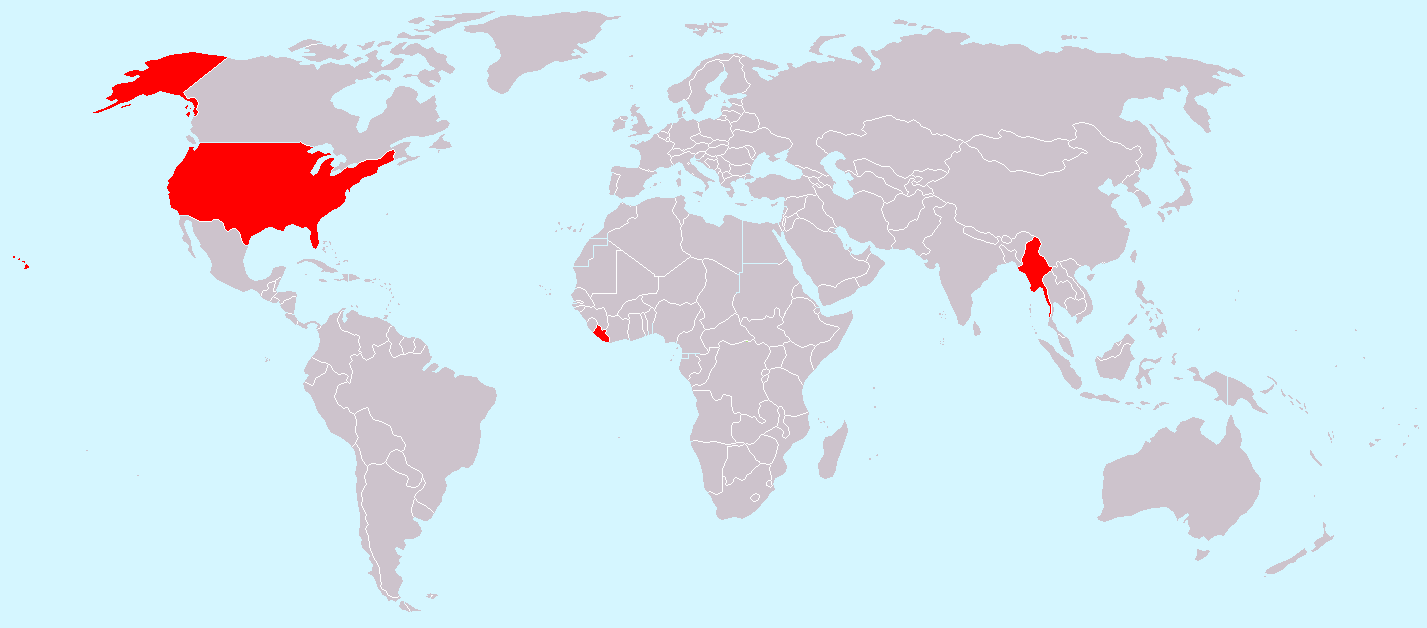
Some countries have not - the United States, Liberia, and Burma (Myanmar). Yes, 3 countries in the entire world have not yet adopted the International System of Units (the metric system) as their primary system of measurement.

A picture is worth 1000 worlds. How about 3 words?

It's time to suck it up and change. I realize it's a pain in the ass, but there is already infrastructure in place to support this on a number of levels. Your measuring cup at home probably has notches for both liters and cups already. Your car's speedometer probably already has measurements for both miles per hour and kilometers per hour.

The main things I will have to get use on a day-to-day basis are noting my weight in kilograms and having a more intuitive knowledge of the Celsius temperature scale. Let's capture the dream.

Wednesday, July 30, 2008

Domain name

So I'm looking to acquire a domain name and then get a web hosting provider in order to give the personal web site thing a try again. The goal is to use the site to host some basic info about myself, possibly this blog, my resume, along with some pet project.

Here are some things I would like to do:
1. Create a content aggregator page. This page would include content from sites, formatted as I choose. It would allow me to aggregate the majority content that I read into a single page.

2. Create the web site using newer technologies I haven't had a chance to play with as much.

3. Host some streaming audio and videos as I see fit.

I know I can get a lot of this for free or even use iGoogle for a hunk of the content. However, that's not the point. The point is to gain knowledge by doing it myself and also to have greater ownership over the project.

The first problem is finding a domain name. I've had several domain names in the past that have expired due to me not caring anymore. I may feel the same way again, but I'm willing to give it another shot. Both of those domains are now off the market due to domain squatters. Bastards. This leaves me with the opportunity to choose a new name that is available in the .com, .org, or .net top-level domains (tld). I'm not willing to take a good name even though it might be available in Malaysia or have a .tv suffix. I need a good name that fits the standard tlds.

The list of available names has disappeared slowly over time due to legitimate ownership and also squatters (bastards). I need a name that I think is cool, but also that is available.

This is proving difficult.

Monday, July 28, 2008

Design flaws

So this weekend I cleaned for the upcoming parental visit. In between shifts as apartment janitor, I played a little Team Fortress 2 (TF2). It's a fun game, but with some frustrating problems.

I was playing one of the converted old-school maps included with the game, 2Fort. It's a symmetrical map where the blue team and red team battle it out to play a more modern, violent game of capture the flag.

I was rocking the shit as I usually do except periodically I would die. Dying is inevitable in TF2. However, the frustrating aspect was not that I died, but rather the manner in which I did. I scored approximately 65 legit kills (not assists) and had about 23 deaths. Approximately 16 of those deaths were the result of cloaked spy players.

The spy is a rather unique class in the game. For killing other players, he is armed with a pistol and knife. For destroying enemy buildings (turrets, health and ammo dispensers, and teleporters), the spy is armed with a 'sapper' which drains the strength of a building until it explodes. The final weapon a spy possesses is a disguise kit. A spy can disguise himself in the form of an enemy class. I lied about the final part. The spy also has a cloaking device to turn completely invisible. This sounds pretty fun and good, doesn't it? The downside to being a spy is they have a very low amount of health and can be killed easily.

It can be observed that the game design intention for the spy was to disguise and cloak deep into enemy territory, sapping enemy buildings and knifing enemy snipers in the back. However, there's a flaw in this game design idea. Very few players actually do this. Most players either play defense, cloak to about mid-level or the more brave go barely to front of the enemy territory, cloak, knife an enemy player, retreat, and repeat. It is efficient and amazingly unbalanced. A spy breaks one of my cardinal sins of good game design in a very horrid way. A spy can not only get a guaranteed first hit on an enemy player, but that first hit is a guaranteed one-shot kill on that player. It's an unavoidable death. Unavoidably horrible.

Now, I understand in more advanced play, teams will be spy checking more often with pyro burst (another class which shoots fire). This still isn't a constant even with good play. Again, here is the winning formula to consistent guaranteed kills.

1. Disguise.
2. Cloak.
3. Uncloak to quickly knife in back for kill.
4. Redisguise and cloak quickly, running away.

No other class in the game has the capability for guaranteed kills. This is horrible game design. Every other class must rely aim or positioning. The only other class in the game that doesn't rely on aim or positioning is the engineer who relies on upkeeping static buildings to do his dirty work. An engineer can never reliably get kills in mid-field or on the front enemy lines because it will be near-impossible to maintain good upkeep on those buildings against good players.

There's a number of other problem areas in the game. Here is what I would do to balance out a few of the weaker classes.

* Soldier
Increase the number of rockets available by 4 to reduce dispenser runs.
Increase the number of rockets loadable by 1 or 2 (to go up to 5 or 6) to equalize demoman grenade spam.
Increase rocket damage due to the risk of playing a more mid-range/close-range class.

* Demoman
Decrease number of loadable sticky grenades to 6. There's no reason a class with high action management should have such a high payload.
Decrease sticky grenade damage slightly. The damage is too high for a class with a blatant action management advantage.

* Spy
Replace the ability for spys to go invisible with the ability to become semi-invulnerable while disguised. Players can still shoot spys to do damage (although significantly reduced while semi-invulnerable), but will not be able to be set on fire during this semi-invulnerability time period thus removing the most obvious sign of being a spy. This means that aware players can still kill disguised spys and also see them coming. However, unaware players will still get a knife in the back.

* Engineer
Buildings are fragile already due to uber rushes and range limitations. Reduce the costs of all buildings so they can be made and upgraded more quickly. The most fun games are when two teams are playing a tug-of-war game to gain positional advantages. Making buildings easier to build will enhance this factor.

* Scout
I wouldn't change much about the Scout. The double-jump with improved speed is very cool and deadly at the hands of a good player.

* Sniper
Reduce all randomness in sniper damage. A headshot is an instant kill. A non-headshot hits for a set amount based on the sliding sniper power scale regardless of where you hit an enemy on their body.

* Heavy
Decrease the scatter shot of heavy fire which will slightly increase damage at further ranges.

* Medic
Increase movement speed slightly to give medics a touch more survivability.

* Pyro
Reduce the length of the pyro fire damage over time effect. There's no reason for a class with higher than average action management to have a DoT effect that lasts as long as it does.

* Game changes
Remove critical strikes entirely with the exception of Kritzkrieg charges and headshots. Random critical strikes add artificial game flavor, but is a detriment to fair play. Randomness sucks hard when it comes to FPS play.

Friday, July 25, 2008

Sugar

I am a fairly intense person when it comes to passionate interests in my life. An interest can be a hobby, a lifestyle change, or a routine. When it comes to food, I am not particularly good at moderation. If I like something I eat it. If I do not like something, I do not eat it again. If I need to lose weight, I am unable to eat poor foods in moderation. I have to cut things out of my diet completely to be successful, else I will inevitably fail at the diet. This is particularly self-evident when observing the amount of sugar in my diet.

I try excessively hard to not eat sugar. Yes, I realize this is impossible. Fruits turn into byproducts of sugar. So do starches, grains, and probably a number of other foods of which I am unaware. I haven't had a candy bar, dessert, or soda since 2002. That's approximately 6 years now. I rarely drink juice, more rarely drink tea (always unsweetened), and never drink coffee. I drink water and a whole lot of it. I try hard to not eat foods with aspartame (e.g. - Equal), saccharine (e.g. - Sweet & Low), or sucralose (e.g. - Splenda) in them. This is near impossible to manage completely, but I try fairly hard to manage.

I do this because I am incapable of eating these foods in moderation and it helps my health. I rarely have cravings for extreme sweetness in my food anymore. If I am dying for something sweet, I'll usually have a banana, an apple, or maybe grapes or raisins.

Out of all the sugar-laden foodstuffs, the food I miss most is ice cream. It is amazingly versatile. I love milkshakes and all varieties of ice cream desserts and, yes, delicious girl-drinks like Mudslides.

I love sweets, but I simply choose not to indulge. I sometimes think about having ice cream some day in the future, and it leaves me wistful for a moment, remembering the texture and taste. It fades just as quickly though. I made a choice and the discipline needed to back that choice is needed. It can be painful, but it also can be empowering.

Thursday, July 24, 2008

The human factor

I am not one of the leading examples of emotional sensitivity in the world today. I definitely could learn a thing or two about getting in touch with ones own emotions and also better understanding the emotions of others. I do understand, on a basic level, standard human emotional instincts.

Globalization has resulted in many U.S. and European corporations going multi-national. This is done to expand their marketplace and also get a step ahead of competitors upon observing or predicting market transitions. The two countries in which countries are expanded to most frequently are China and India. Why China and India? They have enormous populations which means they are a huge marketplace and also a solid target for good local talent. This is most true in China. India is similar with an additional bonus in that they have strong laws and policies in place to protect intellectual property.

In order to meet these marketplaces head on, outsourcing occurs. Jobs that would normally be created in the original host country where the corporation headquarters are stationed are moved elsewhere. It makes business sense in many ways. I will use myself as an example. I know much about the customs and culture of the United States in order to drive development of a product. Development can be defined as requirements, functionality, usability, testing, and marketing research to best fit a particular product to a particular market. The problem is that I can't fill all of these roles when developing a product for India. I don't know the language. I don't know the culture. I can't effectively fill all of these roles, but local talent certainly can.

The problem occurs in the human factor. When jobs are being migrated or opened in outsourced locales, the existing employees get restless. On an intellectual level, many professionals understand the business loyalty is no longer present in the modern workplace. It is rare for an employee to hold the same job for 30+ years, gathering his or her pension, and then move to a condo in Florida. Companies are more fickle. They are more concerned for the inhuman corporation rather than the individual employee. They are more concerned with the shareholders rather than the shareholder. This isn't a diatribe on big brother, but it is a reasonable utilitarian perspective on earning money and developing business success.

Individuals on a non-intellectual level want to feel secure. They want some sort of job security. When that job security is threatened, it causes distrust and low morale. This may seem nonsensical to the non-emotional player. However, it has very real business consequences. It results in lowered productivity and also attrition. The question that businesses need to ask is that how much outsourcing can I manage without tipping the scales overwhelmingly?

I struggle with this issue ethically. I asked my father several times over the years, "Do you ever feel bad firing someone?" He responded, "I don't feel bad because that person always gave me a valid reason to fire them." What exactly defines a valid, ethical reason though?

I understand business reason and I sympathize with the emotional reason of the employee. However, both sides appear so far apart from where they used to be. Globalization indeed. This reason shows more in the form of absolutism and that truly worries me.